
CNS-Selective: The Science of Targeted Treatment
What if a treatment could achieve 80% brain inhibition while sparing the rest of the body? That’s not a hypothetical. The science already exists—and it’s been in development for over 30 years.
Targeted Treatment, Explained
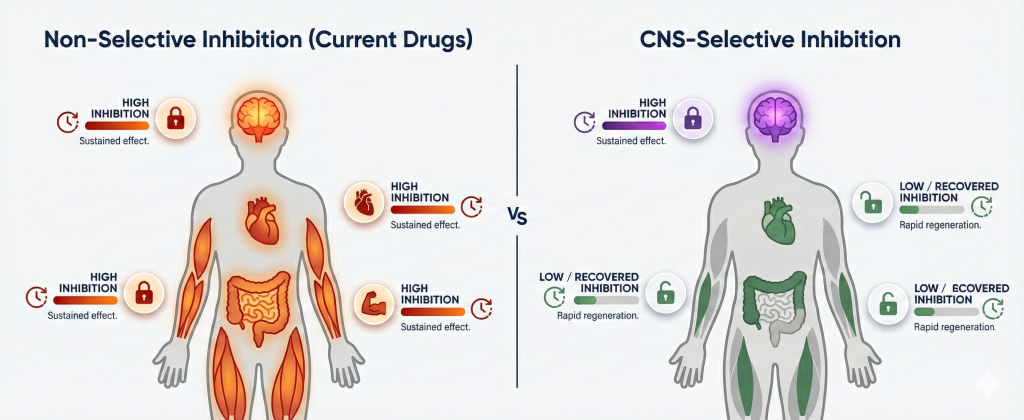
CNS stands for Central Nervous System—your brain and spinal cord. When we say a drug is “CNS-selective,” we mean it concentrates its effects where they matter most while leaving the rest of the body largely unaffected.
Current Alzheimer’s medications don’t make this distinction. They inhibit acetylcholinesterase everywhere—in your brain, your gut, your heart, your muscles. That’s why higher doses bring nausea, vomiting, dangerous heart rate drops, and a list of side effects that force most patients to stay at sub-therapeutic levels.
A CNS-selective approach changes the fundamental equation. Instead of flooding the entire body and hoping enough drug reaches the brain, you design a compound that preferentially acts on brain tissue—achieving the 60-80% inhibition needed for real benefit without the systemic toxicity that makes current treatments intolerable.
This isn’t theoretical pharmacology. It’s a design principle, and it has a working example.
Cnstyx: A New Class of Cholinesterase Inhibitor
Cnstyx (Methanesulfonyl Fluoride, or MSF) is a CNS-selective acetylcholinesterase inhibitor that works fundamentally differently from any Alzheimer’s treatment currently on the market.
Like existing drugs, Cnstyx inhibits the enzyme that breaks down acetylcholine in the brain. But that’s where the similarity ends.
Current medications are reversible inhibitors—they bind to the enzyme temporarily, which means they need to maintain constant levels throughout your entire body to keep working. That constant systemic presence is what drives side effects.
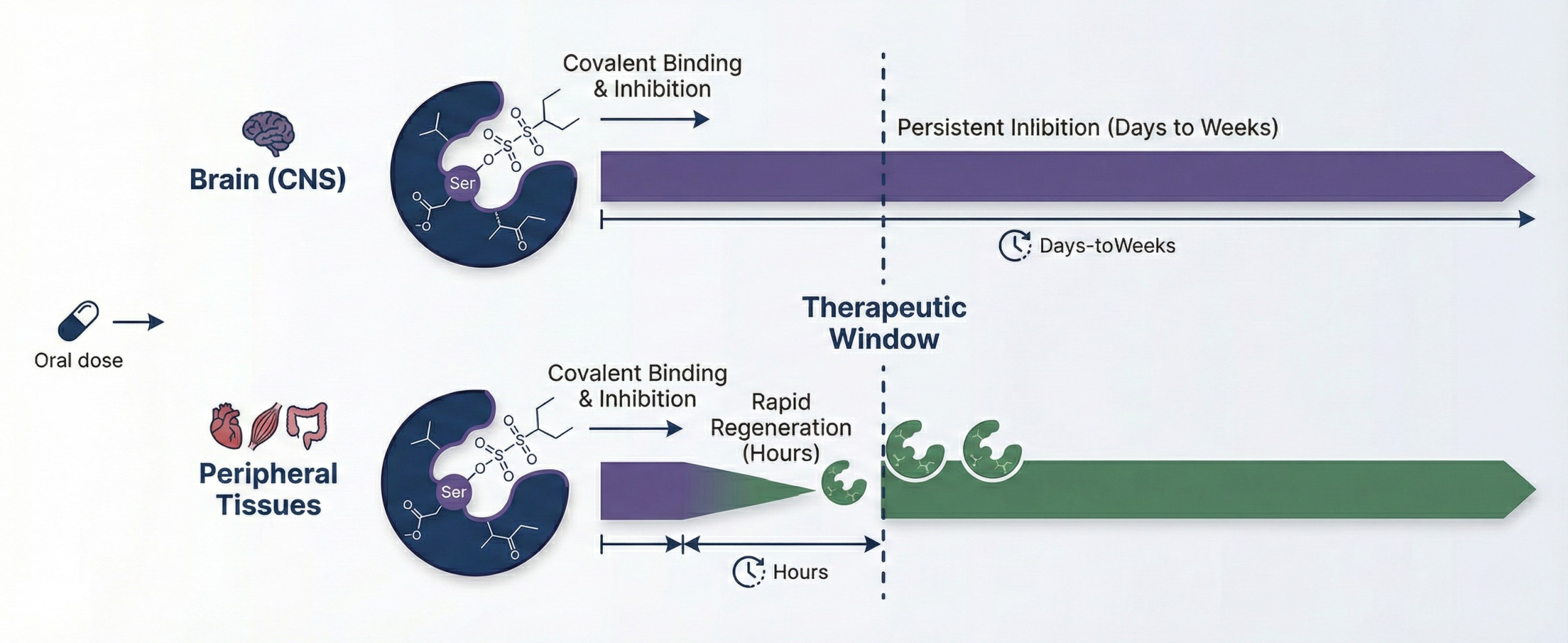
Cnstyx takes a different approach. It forms an irreversible bond with brain AChE, meaning a single dose creates sustained inhibition in the brain without requiring constant systemic drug levels. Meanwhile, peripheral tissues—your gut, heart, and muscles—regenerate the enzyme quickly. The brain holds the inhibition. The body recovers.
The result is what the Sub-Clinical Gap has always demanded: therapeutic-level brain inhibition with minimal systemic effects.
“80%+ brain AChE inhibition achieved in preclinical studies”
“Peripheral enzyme regeneration within hours—not days”
“Oral administration—no IV infusion centers, no biweekly appointments”
“Phase I clinical trials completed”
Mechanism of Action: For Those Who Want the Details
Cnstyx (MSF) is a sulfonyl fluoride compound that acts as an irreversible, pseudo-irreversible inhibitor of acetylcholinesterase. Its selectivity arises not from differential binding affinity, but from differential enzyme regeneration rates between central and peripheral tissues.
Upon oral administration, MSF crosses the blood-brain barrier and forms a covalent sulfonyl bond with the serine hydroxyl at the active site of AChE. This bond is functionally irreversible in central nervous system tissue, where enzyme turnover is slow—measured in days to weeks.
In peripheral tissues, however, AChE turnover is substantially faster. The body synthesizes new enzyme to replace inhibited molecules within hours, effectively clearing the peripheral inhibition while central inhibition persists.
This pharmacokinetic profile creates a therapeutic window that reversible inhibitors cannot achieve: sustained, high-level brain inhibition without dose-limiting peripheral toxicity.
Research spanning more than three decades—including extensive work by Dr. Donald E. Moss—has established the foundational science, preclinical efficacy data, and preliminary clinical safety of this approach.
A Different Class of Treatment
Cnstyx vs. Donepezil, Rivastigmine & GalantamineAccessibility Matters
Cnstyx vs. Leqembi & AduhelmWhere Cnstyx Stands Today
Cnstyx had completed a mini Phase II clinical trial in Mexico, establishing preliminary safety in human subjects. The compound is being developed under a 505(b)(2) regulatory pathway, which leverages existing published literature on MSF to potentially streamline the approval process.
Pathway: 505(b)(2) – Streamlined Approval Potential
Phase I
Completed under prior Patent track. Pre-IND with FDA is required.
Phase II
Pending Funding. This is where your support is greatly needed.
Phase III
Target Goal
30+ years of published research. Phase I complete. The science is ready—the path forward requires resources.
Developed by Memory Science Tech
Cnstyx is being developed by Memory Science Tech (MST), and the Memory Science Foundation serves as MST’s education and advocacy arm.
We believe this connection is a strength, not a conflict.
Direct Access:
Primary Source:
Full Transparency:
No Filtered Press releases
Data direct from the lab.
Knowing who we are and why we advocate.